

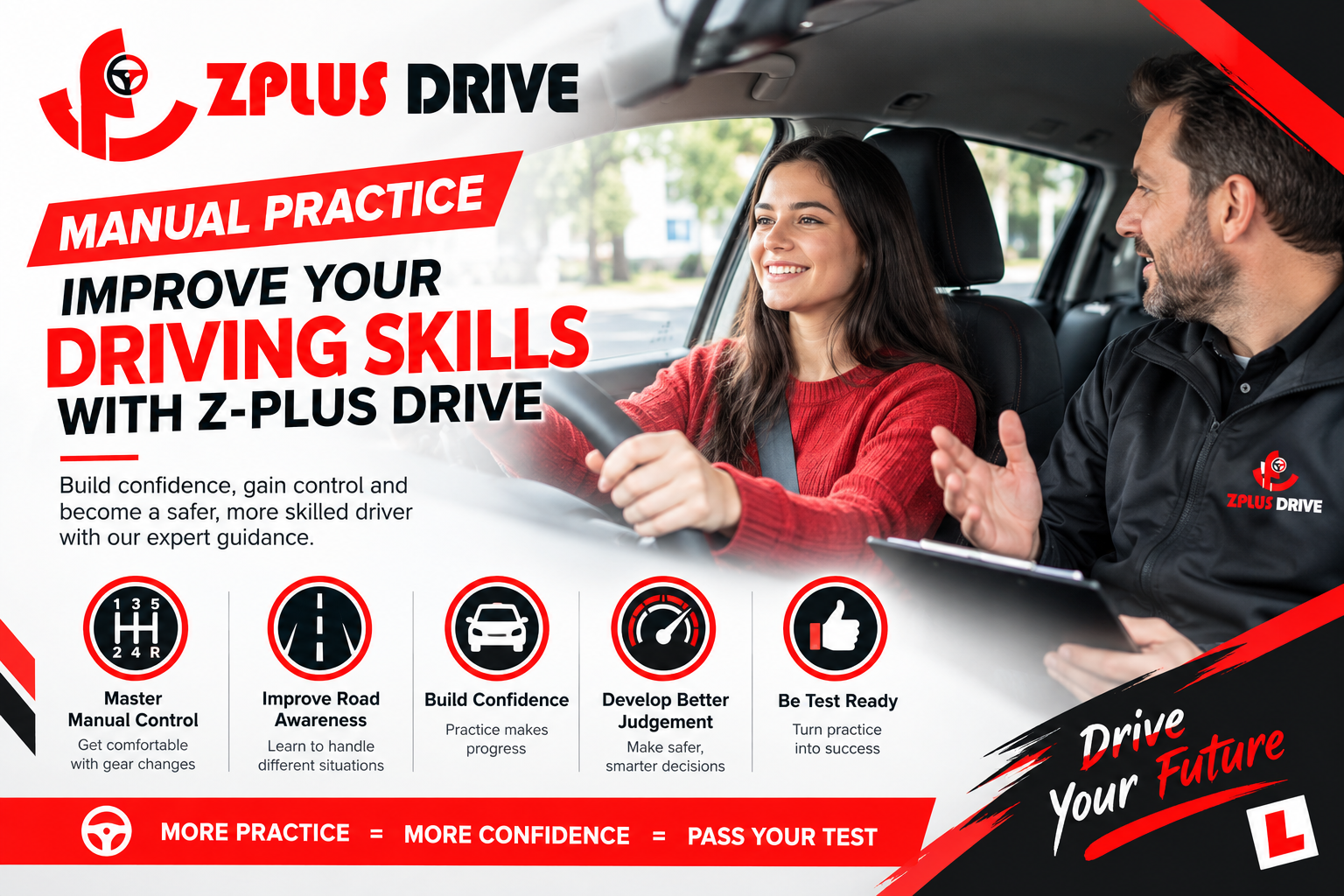
It takes practice and patience to learn to drive a manual car. You have to operate the clutch, shift gears, monitor speed, and observe the road all simultaneously. Initially, these tasks can be challenging. As you practice regularly, you will become more comfortable with each control and drive more confidently. Manual practice is used to develop everyday driving skills and practical driving test skills for the UK. Focussed practice will help you find mistakes and help you develop good driving habits, whether you’re learning to drive for the first time or getting ready for your test.
Z Plus Drive is an ideal first stop for students seeking driving instruction and assistance. A transparent practice plan helps you work on your weaknesses and prepare for various road conditions.
What Is Manual Practice?
Manual practice is learning how to drive a vehicle with a manual transmission. You use the clutch, gear stick, accelerator, and brake to drive the car. You also have to be able to steer, check your mirrors, watch for traffic, and follow the signs.
Manual transmission cars are those that have a clutch and a gear stick shifted by hand. The first gear, for instance, is used to get away from a stop, and higher gears are used at higher speeds when conditions permit.
Clutch control, gear changes, and starting on hills are common issues for new drivers. These problems tend to occur in early lessons. Manual practice will help you to understand how the controls work together in a regular fashion.
Why Is Manual Practice Important?
Manual practice helps you build control and prepare for what you’ll encounter on UK roads. Every session provides an opportunity to practice skills, make corrections, and develop safe habits.
The primary advantages are given.
Better clutch control. Knows how to locate the bite point and leave smoothly.
Smoother gear changes. Better understanding of when to shift gears.
Improved road awareness. You develop skills in controlling your automobile, monitoring traffic, pedestrians, and road signs.
Safer hill starts. You practice driving on slopes with clutch, accelerator, and brakes.
Better parking skills. Experience is gained with reversing, bay parking, and parallel parking.
Greater confidence. In regular lessons, you become more comfortable with common driving activities.
Essential Manual Practice Skills for Beginners
1. Learn Clutch Control
One of the first things you’d want to learn with a manual car is how to control the clutch. The clutch is a mechanism that engages and disengages power transmission between the engine and the gearbox. Smooth control allows you to get away without stopping.
In a proper, quiet place with a certified teacher or qualified supervising driver. Press the clutch in fully and put it into first gear. Gradually increase the clutch until the biting point is reached. Accelerate appropriately and release the clutch slowly.
Avoid lifting your foot too quickly. The engine may stall when the driver is suddenly moving from one position to another.
Repeat several times, then stop and move away. Practice fluid motion and not speed.
2. Practice Changing Gears
Good gear choice will keep you in control and allow you to adapt to the road. It’s important to be familiar with how speed, engine response and road surface conditions influence gear selection.
In Manual gear, practice shifting to 2nd, then to higher gears as appropriate. Know how to shift gears down to slow for junctions, bends and/or traffic.
Drive with a single focus on the road. NEVER look at the change lever when the car is in motion! Learn the gear positions when the car is not moving and in a safe place.
3. Improve Hill Starts
New drivers are often stressed out when faced with a hill start. The car might roll backward if you release the brake before gaining enough control.
Practice on a gentle slope under suitable supervision. Lock the car, find the clutch biting point, and accelerate smoothly to get away.
Your instructor will explain the proper procedure for your car. Avoid holding the car on a slope by slipping the clutch for long periods. Apply brakes as necessary.
4. Develop moving off and stopping skills.
Basic driving skills include moving off and stopping safely. Before leaving, look around, check your mirrors, and check blind spots where applicable. Send a signal and only move when there is no danger.
When stopping, ensure that the mirrors are checked, speed is reduced gradually, and position is appropriate. Repeat the following steps until you perform them without haste.
5. Problems with parking and reversing.
There is a reversing maneuver in the UK practical driving test. You may have to park parallel, back into a parking bay, or pull up to the right and back in.
Select an appropriate practice area and space. Use slow motion and look around when performing each maneuver. Be aware of pedestrians, bicyclists, and vehicles.
Talk with your instructor about what you did wrong with your steering, positioning, and observing. Repeat the maneuver until you can maneuver the car safely and accurately.
How to Make Manual Practice More Effective
Having a structure allows you to focus on specific skills rather than trying to learn everything in one session.
Follow these steps.
Step 1. Establish one target per session. Work on clutch control, gear changes, or parking.
Step 2. Find an appropriate place. Begin in a quiet place, then move to busier roads with an instructor.
Step 3. Repeat each exercise. Repeat the skill, ensuring safe control.
Step 4. Review your mistakes. Identify and discuss with your teacher the circumstances that caused the failure or error, and suggest ways to rectify it.
Step 5. Track your progress. Note and put in writing which skills you feel like you’re good at and which ones you need to focus on.
A concentrated 30-minute practice is a good way to begin practicing one specific skill. Depending on experience, concentration, and the teacher’s suggestions, change the time.
Common Manual Practice Mistakes to Avoid
Many novices make the same mistakes. Knowing what these mistakes are, you can correct them and grow quicker.
- Twisting the clutch out of position. Slowly increase the clutch and become familiar with the “biting point.
- Selecting the incorrect equipment. Match your gear to your speed and road conditions.
- Forgetting mirror checks. Use the mirrors before altering speed or direction as appropriate.
- Braking too late. Anticipate and slow down before hazards.
- Fixing focus on the controls. Before driving away, familiarise yourself with the location of the controls, then focus on the road.
- Panicking after stalling. Lock the car, start the car safely, look around, and clear off if it is safe.
How Manual Practice Helps You Prepare for Your Driving Test
The practical test in the UK evaluates your driving control, road awareness, understanding of traffic rules, and your decision-making skills as a driver.
Manual practice for junctions, roundabouts, pedestrian crossings, meeting traffic, parking, and independent driving. Request your teacher to schedule a mock test to help you determine what you need to work on.
Check responses following each lesson. Concentrate on why it is wrong and repeat that skill.
Before driving for your test, you should feel confident driving on various types of roads. Your teacher will be able to help you judge your progress and readiness.
Obey the UK driving rules while practicing. Possess a valid provisional license, L plates as required, and adhere to supervision and insurance requirements.
FAQs About Manual Practice
Q. What is meant by “Manual practice”?
Manual practice refers to practice driving a vehicle with a manual transmission. You learn how to use the clutch and change gears, and how to stop, turn, and park properly and safely on the road.
One way to practice manual driving is to drive a manual every day. You can practice manual driving daily.
Frequent sessions will help you to maintain your driving skills. Pick a routine appropriate for your experience and progress level, and follow your instructor’s guidance.
Q. Does using the device manually require a lot of practice?
Learning to drive manually can be frustrating because there are several controls to operate. Frequent lessons will help you improve your ability to use the clutch and change gears, as well as your awareness of the road.
Q. What can I do to not get stuck in manual practice?
Gradually lift the clutch until the biting point is reached. Accelerate appropriately and release the clutch gently. When the engine stalls, park the vehicle and start the engine again carefully.
Q. How does manual practice help with the UK driving test?
Manual practice enhances skills in driving control, observation, gear changes, back-and-forth driving, parking, and traffic response. The skills you will be working on are useful for your practical test.
Q. So, should I practice with the driving instructor?
Structured guidance and feedback in professional lessons. Self-employment also involves the proper supervision, insurance, and adherence to UK driving regulations.
Q. What is the duration of manual practice?
Students make different levels of progress. The speed of your improvement depends on your experience, how often you take lessons, your confidence, and how well you can correct your mistakes.
Q. What are my top priorities for skills to learn?
Begin with cockpit checks, clutch control, moving off, stopping and gear change. Next, practice junctions, roundabouts, reversing and parking.
Q. Is there any benefit after the test in manual practice?
Yes. Practicing driving helps keep you on track and deal with different roads, traffic, and trips.
Q. How do I know when I’m ready for my driving test?
Control the car safely, observe the surroundings, make independent decisions, and perform common maneuvers without frequent prompts. You should be evaluated by your instructor.
Improve Your Driving Skills with Manual Practice
Practicing with a manual transmission helps you master clutch control, choose the right gears, handle road conditions, and prepare for the test. Master one skill at a time, practice frequently, and learn from your mistakes.
Z Plus Drive offers an introduction for learners seeking driving advice. You’ll get comfortable as a driver and develop safer driving skills through structured lessons and Manual Practice.